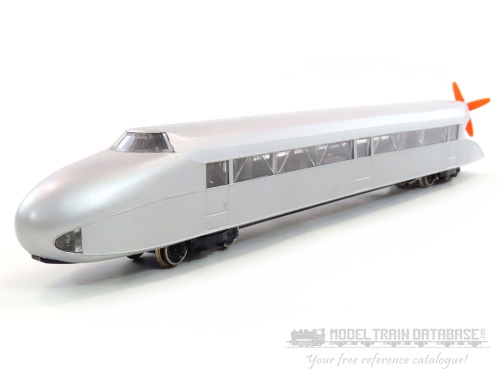
Kruckenberg system Rail Zeppelin. With built-in DELTA module. Metal frame. 2 axles powered. 4 traction tires. Electronic reverse unit. Interior details. Propeller powered by separate motor. Dual headlights. Length 28.8 cm (11-3/8").
In 1931 Franz Kruckenberg's Rail Zeppelin reached the sensational maximum speed of 230 km/h (approx. 144 mph) on a run from Hamburg-Bergedorf to Berlin-Spandau. This made it the fastest vehicle on rails. This world record was not surpassed until 23 years later. The Rail Zeppelin was powered by a 600 hp BMW aircraft motor with a propeller of ash wood. The motor and the drive shaft were canted seven degrees up from horizontal. This kept the unit pressed to the rails during operation. In addition, passengers on station platforms were not affected by the air suction from the propeller. The superstructure consisted of a tubular steel frame covered with sheet metal and fireproof, impregnated sail cloth. The interior was dominated by contemporary chairs of tubular steel in the Bauhaus style. Undoubtedly Kruckenberg was the pioneer for the idea of high speed travel that has reached its present high point with the ICE.
The 3477 Rail Zeppelin was produced as a one-time series only in 1995 on the occasion of the 60th anniversary of Märklin H0 Gauge.