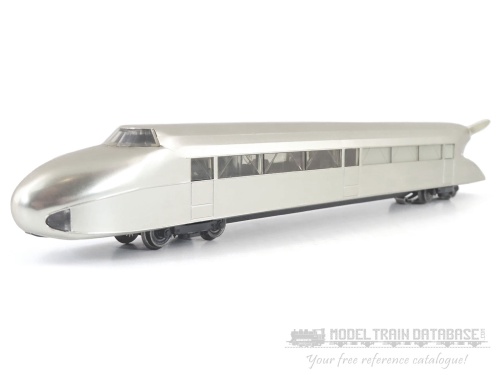
Rail Zeppelin. Based on Kruckenberg System. 2 axles powered. 4 traction tires. At approximately 4 volts the propeller is activated by a small motor and as more power is applied, the Zeppelin begins to move. Dual headlight at the front. Metal frame. Length 28.8 cm (11-3/8").
In 1931 the Rail Zeppelin set a world record on rails with a speed of 230 km/h (143.75 mph) on the route between Berlin and Hamburg. This vehicle was designed by engineer Franz Kruckenberg and anticipated the shapes which are still the standard for streamlining in locomotive/car design. The light-weight construction consisted of a tubular steel framework covered in large part by fire-proof, impregnated sail cloth. The 600 hp aircraft motor and the drive shaft to the oak wood tail propeller were slightly tilted so that the revolving propeller pressed the unit down onto the rails. It was planned that the "Cigar on Rails" would actually work in premium class express service. Despite its achievement during the high speed test, the "Air Railcar" was not successful.