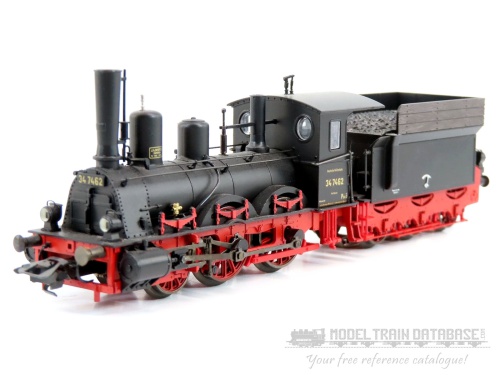
Steam locomotive 310, BBÖ (pre 1938) prototype, wheel arrangement 2-6-4. Model of the 310.05. Five-pole motor with diagonal, dynamically balanced rotor. Drive on two tender axles and via shaft on all locomotive coupling axles. Four wheels with traction tires.
Finest metal spoke wheels, prototypically low wheel flanges. Latticework view-through frame, boiler with separately mounted details, era-typical modifications (e.g. vacuum brakes). Openable smokebox door, driver's cab furnishings. Locomotive-tender close-coupled, close-coupling kinematics on tender. Minimum radius: R2. Total length 248 mm.
The territorial changes in central Europe in 1919, particularly the reduction of Austria to one eighth of its previous size, had a profound effect on the fate of the class 310. Long non-stop runs were now only possible on the Western Route. Due to the difficult economical climate, passenger traffic shrank continuously. Thousands of railway workers, including engine drivers, lost their jobs. This in turn lead to the retirement of more and more engines, among them many 310s. By the mid 1930s, only 17 class 310 steam locomotives were operational, and only four of these in regular service. The political changes brought about by the German occupation in Austria in 1938 were followed by radical changes in the railway administrations. The Austrian Federal Railways (BBÖ) were dissolved and incorporated into the German Reichsbahn. The 40 still existing class 310 locomotives were largely reactivated in order to accommodate the reviving passenger service; one of these locomotives (310.05) was the prototype for our model. The 310, originally conceived for express service by Gölsdorf, again saw traction at the head of the famous Orient Express, as well as on the Berlin-Leibzig route via Regensburg to Vienna. Another route was the Arlberg Express, where the 310 managed 82 km/h despite the long Vienna Woods ascent.
This period therefore represented a new, albeit short, high point in the career of the Austrian flagship engine. As German locomotives were increasingly stationed in the Ostmark (as Austria was then known), the proud engine's fortunes declined. By the beginning of the Second World War, all remaining engines had been reclassified as class 16 locomotives.