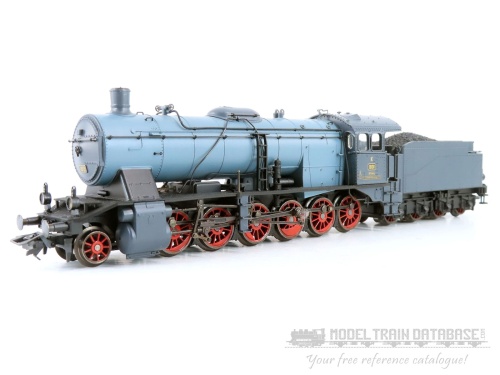
Freight Locomotive with Tender. Royal Württemberg State Railways (K.W.St.E.) class K. With digital decoder and adjustable high-efficiency propulsion. Headlights digitally controlled. High-efficiency motor with bell-shaped armature. 6 axles powered. 4 traction tires. Rigid frame with side play for axles enabling unit to negotiate sharp curves. Adjustable close coupling between locomotive and tender. Detailed engineer's cab. Standard coupler pocket with guide mechanism on the rear of the tender. Free standing lanterns with maintenance-free LEDs. Equipped for installation of smoke generator. Length over buffers 23.5 cm (9-1/4").
This freight locomotive with tender was produced as a one-time series only in 2000 on the occasion of the anniversary "150 Years of the Geislingen Grade".
Starting in 1917 the first and only German locomotive class with 6 coupled axles was built in Esslingen: the legendary Württemberg "K". This unique design was necessary in order to achieve a high level of weight adhesion and thereby the required tractive effort on the steeply graded routes over the Swabian Alb mountains and the Black Forest, while avoiding the need for expensive civil engineering. At that time the most powerful German freight locomotive had an axle load of only around 16 metric tons. This is part of the reason for this locomotive's rather delicate appearance. With a total weight of around 110 metric tons, it was over 2 meters (78") shorter than the heavy class 44 with one coupled axle less. The compact appearance was also a feature of the tender that came in part from class C locomotives that had been re-equipped.
The first units were delivered to the K.W.St.E. and were painted in colors similar to the paint scheme for the famous class C. Additional series with small changes in design went to the German State Railroad after World War I. A total of 44 units formed the class 59 from that time on. For almost 20 years they symbolized the pioneering spirit and railroad technology on the admittedly difficult route over the Geislingen Grade between Göppingen and Ulm.
With the electrification of this mountain route most of the class 59 locomotives in Germany were out of a job and were sent to Austria. Several units wandered to Yugoslavia or Hungary in World War II, and only a few reached the German Federal Railroad. As a subclass they were used infrequently and at the beginning of the 1950s were retired.